Why 2026 Drivers Have So Many Adjustments
Data snapshot: 24 current 2026 drivers across seven brands; checked August 12, 2026
Affiliate disclosure: Some linked driver pages contain retailer or manufacturer links that may earn Stymie a commission. That does not change the specifications, inclusion rules, or conclusions in this analysis.
The 2026 driver rack is not just a lineup of lofts. Two-thirds of the models in Stymie’s current verified set publish movable-weight positions, while a $649.99 price has become the middle of the market.
Adjustability has two separate jobs
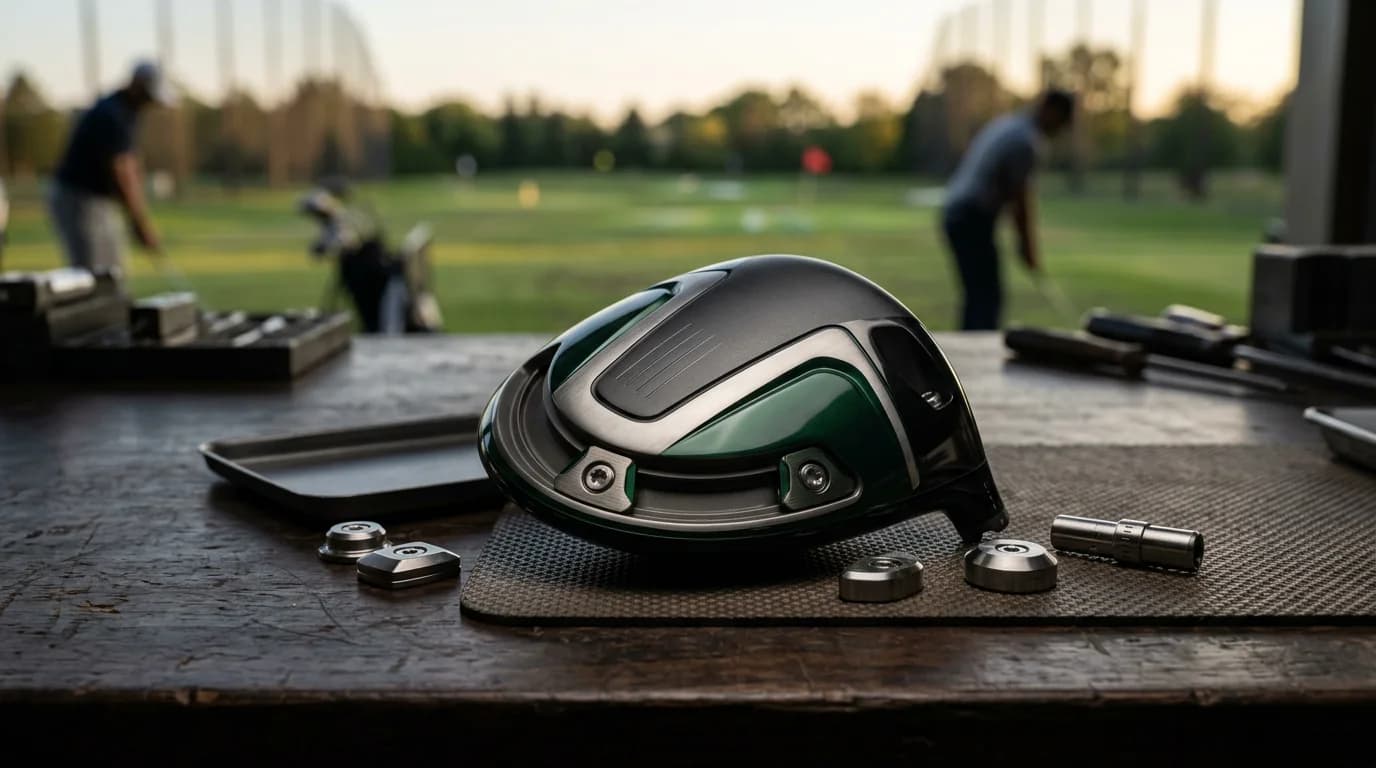
Hosel settings alter the relationship between loft, lie, and face presentation. Movable head weights change mass location. Manufacturers describe those systems with different terms, and a larger menu does not automatically mean a better fit. The useful question is whether a setting produces a repeatable launch, spin, start line, and strike pattern for the golfer holding the club.
Cobra publishes the largest explicit hosel-setting count in this set: 33 across its four OPTM models. Titleist publishes 16 for the GTS2, GTS3, and GTS4. Callaway and Ping publish eight on the models where we have a count. A blank in Stymie’s table does not mean “fixed”; it means our source record does not reduce the manufacturer’s system to a verified numeric count.
| Brand | Models | With movable weights | Max published hosel settings | MSRP range |
|---|---|---|---|---|
| Callaway | 6 | 4 | 8 | $549.99–$699.99 |
| Cobra | 4 | 2 | 33 | $599 |
| PXG | 4 | 3 | Not standardized | $649 |
| TaylorMade | 4 | 3 | Not standardized | $649.99 |
| Titleist | 3 | 3 | 16 | $699 |
| Mizuno | 2 | 0 | Not standardized | $600 |
| Ping | 1 | 1 | 8 | Not published |
The choice explosion is mostly inside families
Seven brands account for 24 models because one nameplate now branches into several head shapes. Callaway has six Quantum models in this snapshot; Cobra, PXG, and TaylorMade have four each. The branch points tend to be familiar—lower spin, draw help, lighter builds, compact or “mini” heads, and higher-stability shapes—but the adjustment hardware varies inside those families.
That matters when comparing prices. A $599 Cobra and a $699 Titleist do not become directly comparable because both have a hosel and movable weights. The published settings describe the fitting envelope. They do not reveal face speed, dispersion, sound, durability, or how often a golfer finds the center.
Six models publish three or more weight positions
Six of the 24 models list at least three distinct movable-weight positions. Those extra positions can expose heel, toe, front, back, or track-based options. They also add decisions. If a fitting produces three nearly identical settings, the simplest stable configuration may be more useful than the one with the most theoretical combinations.
Stymie’s driver comparison is designed for the next step: checking what each manufacturer actually publishes for a specific head. The driver directory keeps unreported fields blank instead of translating marketing language into numbers we cannot verify.
Use the underlying golf data
Explore course scorecards, ratings, rankings, and equipment specifications—then check the source before you play or buy.
Explore Stymie